
Responding to Children’s Ideas: Moving From Noticing to Co-construction
“...the adult’s role is to listen deeply, reflect back what is unfolding, and celebrate the children’s thinking with genuine curiosity, which in turn amplifies the power of their play as a tool for insight and exploration. This kind of interaction requires deep respect for each child’s thoughts and ideas and a sensitivity to the collaborative knowledge-building processes of the group. Far from interrupting children’s play to explicitly call out the “teachable moment” or to direct the play toward an outcome that the teacher desires, this sensitive and thoughtful companioning asks teachers to value what children bring to the play experience: their curiosity, their imagination, and their ways of making sense of things.
Educators who engage with children in this way do so with awareness of the power of their role. Teachers tune themselves to children’s play in order to create extended opportunities for children’s investigations into compelling concepts and ideas that are thoughtfully aligned with the children’s existing curiosities.”
-Finding Our Way: Developing a Shared Pedagogy, p.140-141
In a responsive approach to curriculum, learning design is not separate from observation and documentation. Instead, it emerges directly from the careful study of children’s thinking. The process of working in this way moves away from constructing a pre-determined program and instead offers a generative act of research, rooted in collaboration and shaped through ongoing cycles of listening, documenting, interpreting, and reflecting.
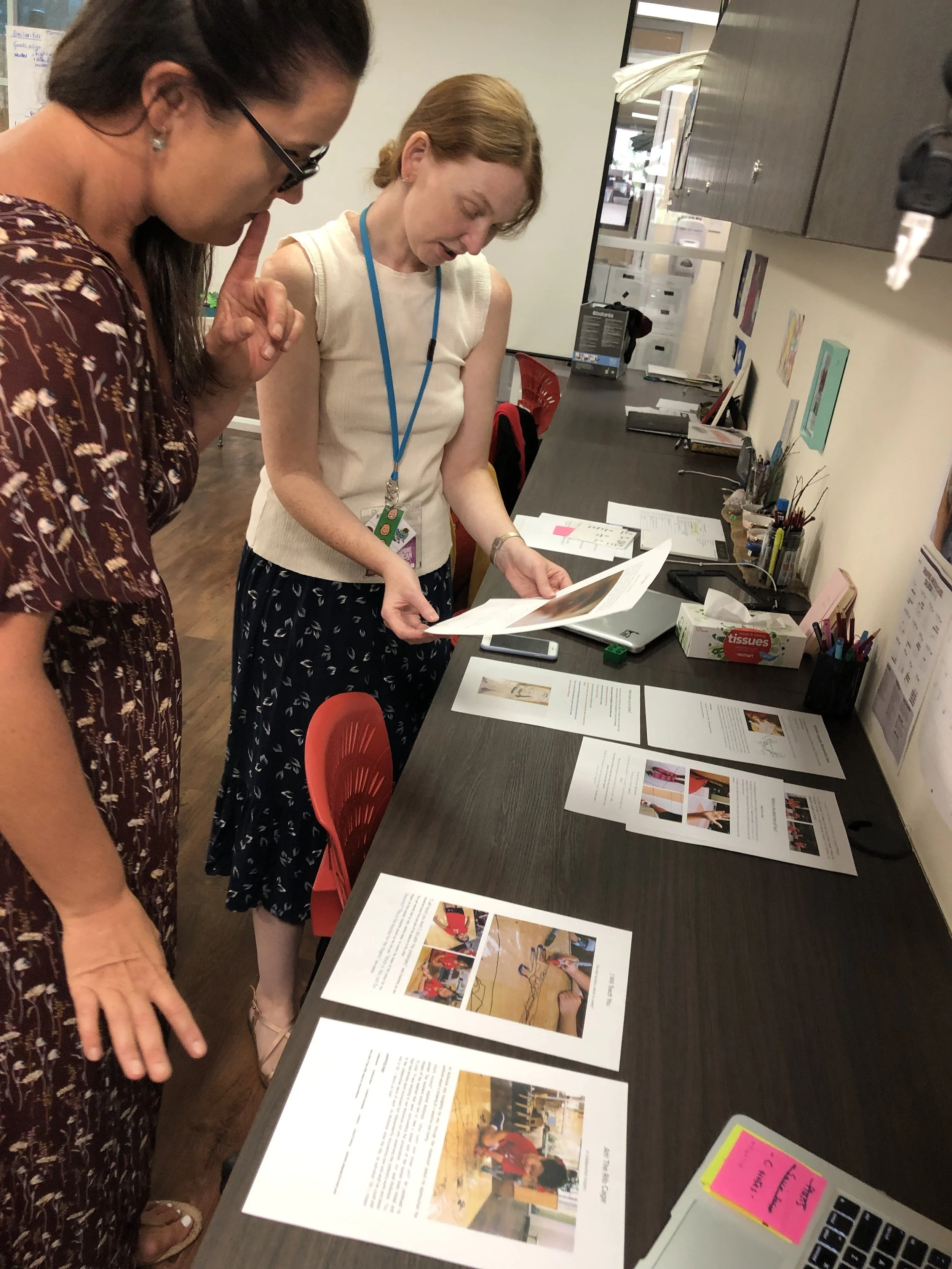
The creation and analysis of documentation then become essential processes that allow teams to trace the evolving threads of children’s thinking over time. When educators revisit photographs, transcripts, videos, drawings, and anecdotal notes together, patterns begin to emerge. Connections and interconnections between experiences, ideas, and concepts become visible. Through this collaborative process, teaching teams begin to notice how children might return to ideas repeatedly, refine their theories, test possibilities, and build increasingly complex understandings.
“Planning is understood as a living, recursive process deeply embedded in cycles of observation, listening, documentation, reflection, and co-construction. It invites teachers to remain open to the unexpected, to follow the evolving threads of children’s thinking, and to collaborate with their colleagues in determining what matters next.”
-Finding Our Way: Developing a Shared Pedagogy, p.217
The reflection embedded in the planning process supports teams in refining their approach, and as they do so, they are prompted to thoughtfully consider and articulate their pedagogical decisions. Rather than asking, “What activity should we do next?” or “What resources shall we put out?”, teachers reframe their thinking and start to ask very different kinds of questions, such as:
What ideas might children be trying to understand?
What conceptual understandings are deepening through this exploration?
What perspectives are emerging?
What contradictions or tensions might the children be encountering?
How could we sustain or extend this investigation?
As part of this process, teachers might create invitations, provocations, or proposals for children to engage with, depending on the concepts being explored. Such engagements are intentional offerings of materials, questions, and experiences designed to deepen, provoke, or reframe children’s investigations. They invite children to think further, revisit ideas, encounter complexity, and explore new possibilities. This might involve introducing a new material, revisiting documentation with children, reconfiguring the environment, or offering new perspectives through carefully selected questions, books, or images.
“Ideas become trusted companions in learning. Children build relationships with concepts and questions, returning to them again and again in new and complex ways. When teachers create space for children to linger with ideas, to test theories, and to connect them to lived experience by creating time and space for play with rich, open-ended materials and offering thoughtful proposals anchored in children’s thinking, learning becomes multifaceted, layered, and rich. By proposals, we mean “considered invitations or prompts from teachers designed to ignite or extend children’s thinking.”
Finding Our Way: Developing a Shared Pedagogy, p.122
For example, a group of children exploring shadows cast by branches on a tree may initially focus on shape or size. However, on closer analysis of the collected images, notes and documentation of this inquiry, the educators begin to recognise that there are two different conceptual ideas underlying this exploration: movement and change. As a response, educators then offer a digital projector, a range of materials and video so children can revisit their shadow play at different times throughout the day and watch recording of their shadow play afterwards. This responsive scaffolding deepens the children’s investigations while still leaving space for new possibilities.
New opportunities to extend children’s research and thinking emerge through close listening, documentation, and collaborative analysis. In turn, this documentation - shaped by traces of children’s thinking - becomes the basis for shared interpretation, which then informs the proposals designed to further provoke and extend their ideas. Through this renewed lens on curriculum and learning design, we see that it remains closely connected to children’s lived experiences rather than disconnected from them. This way of working requires openness to uncertainty, as children’s inquiries can sometimes move in unexpected directions, provoking entirely new questions.
Ideas such as these expand our understanding of the entire process of developing a shared pedagogy alongside the members of the team. And - while it is essential to engage in this work collaboratively with colleagues, pedagogical co-construction is only truly realised when it also involves children—taking our understanding of shared pedagogy to a deeper level of meaning, participation, and responsibility.
Co-constructing curriculum with children is therefore not a strategy or technique; it is a courageous practice and an ethical stance—one grounded in deep respect for children’s thinking and a belief that learning emerges through relationships, dialogue, and shared inquiry. It is an open and generative invitation to working differently as we travel forward together. We wonder…
What opportunities might you have to engage with the co-construction of curriculum with children?
What might change in your practice if you lean more fully into children’s ideas and theories?
How would this process help shape your team’s pedagogical stance?
Fiona and Anne