
Finding Our Way: Developing a Shared Pedagogy
As we move into the final stages of editing and design, we are excited to share a few morsels from our book – some glimpses of the big ideas and enduring understandings that animate its pages. These are the concepts that surface again and again across the chapters, deepening, shifting, and expanding as they unfold through stories of practice, theory, and lived experience. They have held us steady in the writing process and supported us to stay true to the course ahead. What follows is one such idea: a way of thinking that helps us make sense of complexity, navigate uncertainty, and stay oriented to what matters most in early childhood education - much like wayfinding by the stars, where meaning emerges through relationships, patterns, and the constellations we create together.
“The cosmos is within us. We are made of star-stuff.
We are a way for the universe to know itself.”
— Carl Sagan

Long before GPS, before maps were flattened onto paper or illuminated on screens, people looked up. They read the night sky. Stargazing and wayfinding were not abstract pursuits but essential practices for life, supporting survival, storying, and belonging. The stars offered orientation in a vast expanse of darkness: points of light that, when read in relation to one another, helped people work out where they were and where they were going.
There is something deeply resonant about this ancient practice for those of us working in early childhood education.
Constellations, after all, are not things in the sky. They are constructs. Human-made patterns drawn between stars that already existed, imagined into relationship so the night sky could be navigated, remembered, and shared. The stars themselves are independent - burning, distant, unknowable - but it is the lines we draw between them that create the meaning. In ancient times, constellations were conjured as a way of mapping the unknown, recording knowledge, and making sense of the immensity of the universe and our place within it.
And, for us, this is where the metaphor begins to really resonate.
Teaching teams, like the night sky, are made up of individuals - each with their own histories, beliefs, practices, strengths, contradictions, questions, and luminous ideas. Just as no two stars are the same, no two educators bring identical perspectives to their work. Coming together as a team, to develop a shared pedagogy in the spirit of inquiry and collaboration, takes time and courage. Much like the ancient wayfinders, teachers chart their path across the year by taking constant readings of where the children have been, where they are and where they are heading next in their learning. This process asks every member of the team to hold curiosity and reflection in their hearts and minds as they come together to work out where they are, decipher the journey of learning that has brought them to this point, and begin to design possible ways forward. In this process of navigation, it is not the brilliance of any single star (or team member) that enables the wayfinding; it is the relationships between them. It is this collective act of orienting ourselves - of reading the skies together, questioning, recalibrating, and moving forward in relationship - that has led us to title our book Finding Our Way: Developing a Shared Pedagogy.
Celestial navigation is the practice of working out where you are and where you are heading by reading the position of stars in relation to one another. It is relational, contextual, and dynamic. The stars do not move for you, but your understanding of their alignment shifts as you travel. In this way, navigation is less about certainty and more about attunement.
Developing a shared pedagogy in early childhood education asks something similar of teaching teams.
Shared pedagogy is not a fixed document or a set of agreed phrases pinned to a wall. It is an ever-evolving set of relationships between values, theories, practices, children, families, environments, and educators. It is something we actively construct together, often in moments of uncertainty, change, or expansion. Just like constellations, it is shaped by what we choose to notice, what we name, and the lines we draw between what matters and where we are going next. When leaders and their teams come together to articulate their pedagogy, they are engaging in a kind of wayfinding. They might ask:
Where are we now?
What are we noticing in the children, the learning and the community?
What guides us when the learning or terrain shifts
Which ‘stars’ (or data points) do we trust as we orient our decisions?
In this process, each educator becomes a navigational guide, holding particular insights about children, curriculum, relationships, ethics, and possibilities. One brings deep knowledge of play. Another holds a strong commitment to equity. Another recognises the environment as the third teacher. Another listens closely to children’s working theories. None of these, on their own, is enough to chart the journey. But together, in relationship, they form important understandings that can guide the shared practice of the team.
Importantly, constellations are culturally and historically situated. Different cultures have mapped the same stars in different ways, telling different stories, naming different relationships. This reminds us that pedagogy is never neutral – it is a contextual and cultural embodiment of values, beliefs and experiences. The constellations we create with our teams illuminate what we value, how everyone’s voice can be central, and inform which stories of practice we choose to build and carry forward.
In times of change, be it in new teams, new spaces, or with new expectations, it can be tempting to search for a single bright star: a program, a framework, a leader who will tell us exactly where to go. Yet the ancient navigators never relied on one fixed point of certainty. They remained curious and alert, restlessly reading the skies in order to come to know them more deeply. They trusted systems, not singularities. They learned to read complexity.
For teaching teams, developing a shared pedagogy requires slowing down enough to look up together. To notice one another. To speak beliefs aloud. To sit with difference and tension. To ask not just what we do, but why we do it - and how our individual orientations shape the collective path.
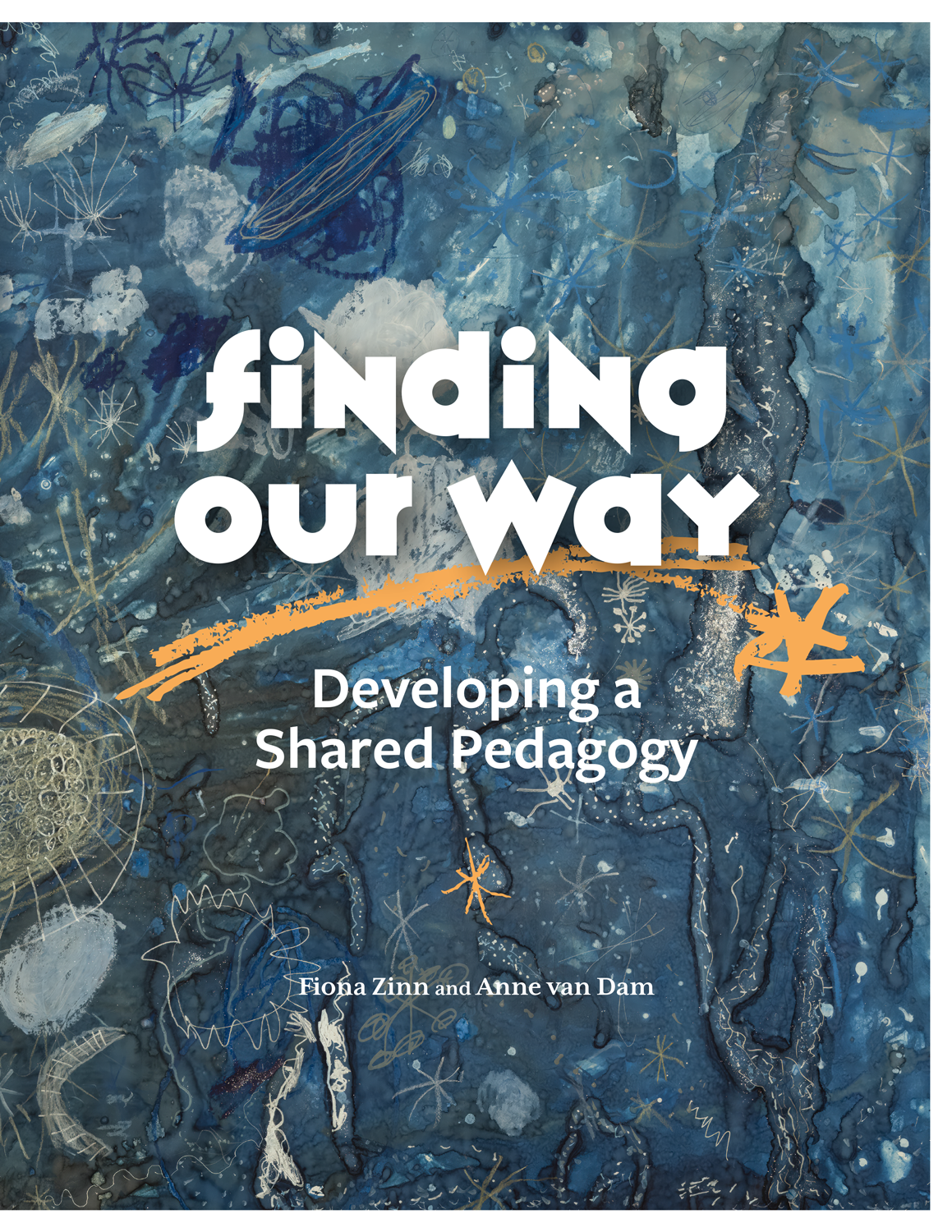
As we bring this reflection to a close, our heartfelt thanks go to the many schools and early childhood centres who have so generously shared their stories and images from our years of working together. Your openness illuminates the power and possibility of collective practice. Thank you for being part of the many constellations of practice and pedagogy that have given form to this book — we can’t wait to see how these stories resonate with our readership.
And finally, we offer special thanks to The Friends' School, Tasmania, for their kind permission to include the stunning image of a galaxy, painted by four- and five-year-old children, on the cover of the book. Its depth, brilliance, and intricate detail beautifully echo the ideas at the heart of our work: that learning, like the cosmos, is shaped through relationship, wonder, and the shared act of finding our way - together.
Fiona and Anne